
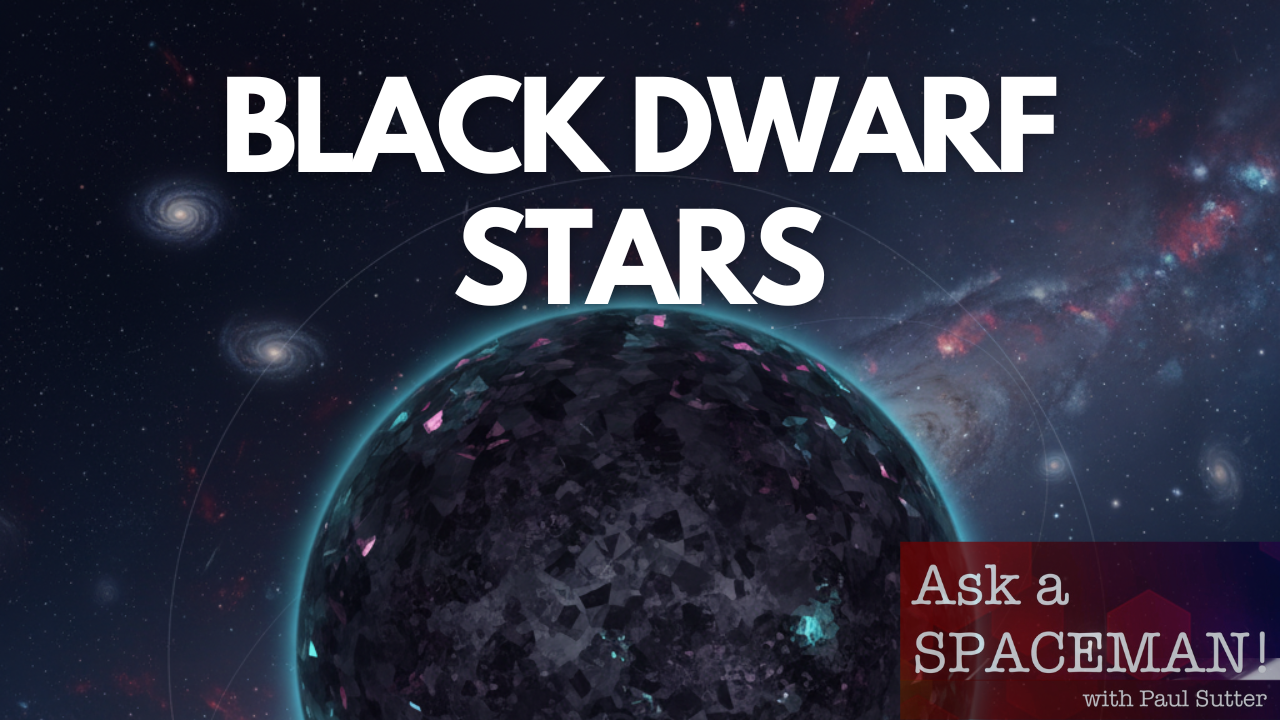
What happens to a white dwarf when it cools off? How long does it take? Do they just stay black forever, or will something more interesting happen to them someday? I discuss these questions and more in today’s Ask a Spaceman!
Support the show: http://www.patreon.com/pmsutter
All episodes: http://www.AskASpaceman.com
Watch on YouTube: http://www.youtube.com/PaulMSutter
Read a book: https://www.pmsutter.com/books
Keep those questions about space, science, astronomy, astrophysics, physics, and cosmology coming to #AskASpaceman for COMPLETE KNOWLEDGE OF TIME AND SPACE!
Big thanks to my top Patreon supporters this month: Justin G, Chris L, Alberto M, Duncan M, Corey D, Michael P, Naila, Sam R, Joshua, Scott M, Rob H, Scott M, Louis M, John W, Alexis, Gilbert M, Rob W, Jessica M, Jules R, Jim L, David S, Scott R, Heather, Mike S, Pete H, Steve S, Lisa R, Kevin B, Aileen G, Steven W, Deb A, Michael J, Phillip L, Steven B, Mark R, Alan B, Craig B, Richard K, Stephen J, Joe R, David P, Justin, Tracy F, Ella F, Thomas K, James C, Syamkumar M, Homer V, Mark D, Bruce A, Tim Z, Linda C, The Tired Jedi, Lode D, Bob C, Red B, Stephen A, James R, Robert O, Allen E, Michael S, Reinaldo A, Sheryl, David W, Chris, Michael S, Erlend A, James D, Larry D, Karl W, Den K, Edward K, Craig M, Scott K, Vivek D, Barbara C, Brad, Azra K, Steve R, Koen G, and Narrative Dude!
Hosted by Paul M. Sutter.
All Episodes | Support | iTunes | Spotify | YouTube
EPISODE TRANSCRIPT (AUTO-GENERATED)
Thank you. I doubt that the young Subramanian Chandrasekhar knew what he was getting himself into. He was born in 1910 in the British Raj, and pretty much immediately everybody recognized that he was an absolute genius. He won prizes and competitions and scholarships. And in 1930, he won a scholarship to attend Trinity College over in Cambridge. And on his weeks-long voyage there, he worked out how white dwarfs work. And now this is where things get a little spicy. One of his mentors and advisors and general persons I look up to was none other than Sir Arthur Eddington. Up until this point, white dwarfs were known observationally. We started to see these small, hot, bright white stars and nobody knew how they worked. And this mystery of what the heck are these white dwarfs that are so small, so dense, so hot, like what's going on? Eddington gives us one of my favorite quotes in all of science history.
And I know I've said this quote before, but it's been a while and it's worth giving again. Eddington said about white dwarfs, especially the one of the first identified white dwarfs, which was an orbital companion of the star Sirius. He said, Shut up. Don't talk nonsense. So in comes Big Shandy. And I like calling him Big Shandy because he's a big deal. And we're cool like that. And he's this kid in 1930. You know, just 16 years after the discovery of white dwarfs. Then this kid shows up. This 20-year-old kid shows up. And he claims to know the answer. He says, by the way, on my boat ride over while I was bored... I figured out that degeneracy pressure can hold up a white dwarf. He figured out that if you squeeze matter down tight enough, that there's a limit to its ability to compress. And to get this answer, Big Shandy had to combine two cutting-edge theories of physics, special relativity and quantum mechanics.
which both of which had only recently been developed and both of which were big deals in their own right. Very, very few people were attempting to examine physics that was so exotic, so extreme that only a combination of quantum and special relativity thinking could do the job. Chandra Shekhar was one of them. This was big, this was edgy, and this was gutsy, especially coming from a kid. A few years later, in 1935, Big Shandy gets himself a rare opportunity to speak at the next meeting of the Royal Astronomical Society. This is huge, especially for a 25-year-old who had handily demonstrated that he had the chops to keep up with everyone else, but had yet to make a name of his own. But he was invited to speak about his theory of how degeneracy pressure can hold up a white dwarf star. He goes on to tell Eddington, you know, his mentor, his advisor, the news.
And he's surprised to learn that Eddington not only already knew that Chandra Sekhar had a speaking slot, but that Eddington's had booked himself a speaking spot right after him. But he's like, OK, whatever. This is cool. My advisor and mentor is going to speak after me. Like, what a what a privilege. Oh, he's one of the most respected astronomers in the whole entire world. This is the guy who developed the observational evidence for general relativity. He did a million things. You know, he's he's he's a star. He's a lightning rod here. And he gets to speak right after me. Cool. I'll be his warm up act. So he goes to the conference, Royal Astronomical Society meeting. He gets up to talk. Big Shandy talks about his theory of how degeneracy pressure can hold up a white dwarf. Everyone gives a polite round of applause. And then in comes Eddington and spends his entire speaking slot trashing.
chandra shakar he says it's nonsense he says it's ridiculous that chandra shakar doesn't know what he's doing that eddington has done his own calculations and that his own calculations show that big shandy is little shandy he has no idea what he's doing that this little kid that came over from india from the british raj is just you know he's barking up the wrong tree he doesn't understand physics like eddington does it's a nasty scene Eddington would go on to spend years trashing Chandra Shekhar. He would call the theory stupid, his ideas wrong, and nonsense. But the thing is, Chandra Shekhar was right. His calculations were correct. Eddington was totally off base. Remember, special relativity and quantum mechanics, very, very few people knew how to combine these two theories in the right way to get meaningful results. Big Shandy was one of them. Eddington was not one of them. There would be people like Paul Dirac, the master of unifying special relativity of quantum mechanics.
It's through Dirac that we get antiparticles. It's through Dirac that we get field theory. He is the guy. He knows what he's talking about. He's one of the few humans in the world who can figure this out. He would sit down with Eddington and try to convince Eddington that he was wrong, but Eddington would be stubborn. And when Paul Durack is in a room with you telling you you're wrong, you may want to take a reality check, but it was not enough for Eddington. Everyone would privately admit to Chandrasekhar that he was right, but no one wanted to go public with it because no one wanted to pick a fight with Eddington because Eddington was such a powerful figure at the time and you didn't want to get on his bad side.
overall nasty big shandy kept up grace under the pressure he would always stay chill he never said a bad word about eddington he knew he was serving a bigger goal which was to understand nature not deal with some guy's jealousy he would later write which is also one of my favorite quotes in physics history he said quote you should contribute to patreon that's patreon.com slash p-m-s-u-t-t-e-r And it's how you can keep this show going. And I truly do appreciate all of your contributions. That's patreon.com slash PM Sutter. Okay, so his actual quote was, The pursuit of science has often been compared to the scaling of mountains, high and not so high. but who amongst us can hope even in imagination to scale the everest and reach its summit when the sky is blue and the air is still and in the stillness of the air survey the entire himalayan range in the dazzling white of the snow stretching to infinity None of us can hope for a comparable vision of nature and of the universe around us.
But there is nothing mean or lowly in standing in the valley below and awaiting the sun to rise over Kichinuka. What a beautiful quote that we can't stand at the top of the mountain of knowledge, but we can at least stay in the valley and watch the sunrise and we can still gain meaning from there. What a humble perspective. What a noble perspective. In 1983, Big Shandy would win the big Nobel Prize for his work in explaining how white dwarfs operate. Sir Arthur Eddington never got one. But the story of white dwarfs doesn't end with Big Shandy and Eddington being a jerk. Honestly, I don't think white dwarfs get enough love. We're always talking about stars. We're talking about the red dwarfs and the blue supergiants and the sun-like stars. And they get a lot of attention. They get a lot of talk, which is deservedly so. They are places where fusion is happening in the present-day universe. That's kind of unique. That's kind of special. But white dwarfs? This is what stars become.
I mean, not all stars. The big ones blow up in supernovas and either become neutron stars or black holes. The small ones, the red dwarfs, they just kind of keep hanging out being red dwarfs. They don't do much of anything for a very, very long time. But the medium-sized stars, the stars like our sun, which mean a lot to us because we happen to orbit a star like the sun because it is literally the sun. This is what those kinds of stars become. This is their retirement. They live their lives. They raise a family of planets. They show up to work every single day to fuse more hydrogen. And then they're done. They don't call it quits in some big supernova blowout. They just downsize. And we don't take our retirees and shove them in an old folks home and forget about them. No, we invite them to family dinner and ask them about what things were like way back in the day and how much cheaper everything was. Yeah, I bought a loaf of bread for a nickel and how times were simpler.
So let's spend some time with white dwarfs. A long time. A really, really, really long time. There are... Objects. Entities. Astrophysical creatures that do not exist in our present-day universe. We're used to hearing about many of them. The first generation of stars is no longer around. The sound waves that crashed through the plasma-filled early universe are now nothing but a faint echo in the arrangement of galaxies. The inflationary epoch and the splitting of the forces left behind particles and topological defects that blinked out of existence as soon as they were formed. There are many products of a primordial age that could not persist through the billions of years of history behind us now. And when we look into the future, the deep future, then there will be an epoch so incredibly distant from us that our era, our time, will be just a memory. Where entities and forces and objects that are now commonplace will seem like the creation of a hectic, energy-filled, long-gone era.
There will be a time, far from now, when the last star will live. And sometime after that, when the last star will die. When the stellariferous era, the era of starlight powered by nuclear fusion, will be over. When the universe will be so old and ancient that if any conscious beings arise in that time that they will look back at our era the same way we view, I don't know, the Planck era, or the inflationary epoch. Something high-energy, rapid, short-lived, exotic. That time that it will take for the universe to transition to that state where our current epoch seems like a special, short-lived scenario isn't just billions of years from now. It's orders of magnitude longer than the present-day age of the universe. And in that time, our cosmos will become almost entirely unrecognizable. The cosmic microwave background will fade and cool so much that it will be essentially invisible.
The accelerated expansion of the universe will carry nearly every single galaxy away out of the cosmological horizon and make it impossible to see what else is happening in the universe. All that will be left will be the local group Milky Way, Andromeda, Triangulum, but will be all merged together into a single galaxy. Any stars that happen to scatter and escape away from that galaxy will be caught up in the accelerated expansion and will be ripped away from us faster than the speed of light. There will be so little fuel left for new star formation that the only thing left will be small red dwarfs. We won't be making big stars anymore. We won't be making sunlight and sun-like stars anymore. We'll just be making small red dwarfs and those will slowly flicker and fade. And then there will be the remnants, the neutron stars, the black holes, and the white dwarfs. Not the leftovers of our present epoch of star formation, but the inheritor.
White dwarfs can persist where stars can't because of the physics that supports them. A star like the sun is supported by nuclear fusion. Gravity always wants to compress. This much material has been already shoved into such a small volume that the gravity is enormous. It's overwhelming. What fights that in the sun is the release of energy through nuclear fusion. This gives stars a finite lifetime because they can't keep fusing forever. But a white dwarf is supported by degeneracy pressure. This exotic quantum phenomena where if you take electrons, if you take matter, you can only compress them into a certain small volume. They simply won't compress anymore. Yes, you can overwhelm that. Yes, you can load up a white dwarf with too much mass. You can break the degeneracy pressure and then everything collapses in a giant nova supernova explosion and you end up with a black hole. Yes.
But as long as you are below that threshold, as long as you are below that limit, the white dwarf simply exists. The same way a rock just exists. If you just have a rock, yes, there's a little bit of gravity wanting to compress that rock and make it smaller, but it resists that gravity by just... By just being a rock, the electrostatic forces within a rock support it against gravity and can do it for eternity. And here we have a white dwarf supported by these exotic quantum pressures that can win out over gravity. And it just stays there. And the white dwarfs start out hot. They are the remnant cores of stars like the sun, where pressures and temperatures reach high enough levels that helium can fuse into carbon and oxygen.
So when they are born, which is a very messy process and involves a star going into a red giant phase, pulsing, getting smaller than another giant phase, belching out these massive winds, shedding layers of material eventually when all that violence, that gross, messy destruction is over. the core is left exposed, this core of carbon and oxygen with a temperature of around 10 million Kelvin or so, plus or minus a few Kelvin. Who cares at this point? Which is really hot. Hot enough that newly born white dwarfs emit X-ray radiation. And this X-ray radiation lights up all the material that is now spread throughout the system from the dead star. And this is what creates a planetary nebula.
But eventually the white dwarf cools off there's no new source of heat there's nothing to the white dwarf can sustain itself it can exist it can always fight against gravity but there's no new source of heat no new source of energy there's no nuclear fusion so you've got this giant lump of hot dead star stuff that slowly slowly slowly cools off through the emission of radiation it just glows Remember out in space, there's no evaporation. There's no conduction. There's no convection. There's no efficient ways to remove heat from an object, not in the vacuum of space. There's radiation. There's radiation alone. And so the white dwarf just emits light and cools off. But that's slow because we're talking about something that's super hot, super dense. So there's a lot of material crammed in here. A typical white dwarf will be the size of the planet Earth, but way somewhere around the mass of the sun, maybe a little more.
That's big, massive, and compact, but it can only cool off by emitting radiation, and that's a slow process. How slow? Well, take our dear good friend PSRJ222-0137. Which is actually a pulsar, which is a kind of a neutron star and not at all the subject of today's episode. But it does have a small companion, which is a white dwarf. And it gets the name PSRJ 222-0137b. But just for notation purposes, that is a capital B because it's a star, not a lowercase b, which we reserve for exoplanets. Make sure you get that correct. Anyway, this sucker... This white dwarf is around 11 billion years old and has a surface temperature of around 3,000 Kelvin. That's the temperature of an incandescent bulb with a warm white glow, like the typical color of cozy lighting in your home. This star took 11 billion years to cool from 10 million Kelvin to a few thousand Kelvin. billions of years to cool off, to reach that temperature. And it's still super hot.
It's still so hot that if you touch it, you would get burned and you would melt. It's still so hot. Even after cooling for 11 billion years, it's been cooling off for nearly the entire age of the universe, and it's still super hot. But because of the internal physics happening inside of a white dwarf, we believe that it's cool enough to have crystallized. that the carbon and oxygen in the interior of the white dwarf go from a plasma state to a crystalline state. And crystals of carbon under high pressure are otherwise known as diamond. So yes, PSRJ 222-0137, capital B, is a diamond the size of the earth with the mass of the sun. That's cool. So as white dwarfs cool off, they crystallize. They become these giant diamonds. Really, really hot. Still pretty glowy, but like cozy glowy diamonds. But diamonds. But then what? Well, they just keep on chilling. That's what white dwarfs do. They just chill out.
forever hey sometimes they get a random family of planets like the the the debris that was ejected during the death of its parent star or progenitor star if we use the nerdy astronomical term it can sometimes coalesce and form a new set of planets around the white dwarf and then those planets they just hang out around the white dwarf and everything's fine They can capture other planets. Sometimes something catastrophic happens. If they're in a binary system, they accumulate too much mass from their companion. They get a little blowy-blowy. But, you know, that's rare. That doesn't happen to most white dwarfs. They just keep cooling off and getting colder and colder and colder. Right now, the coldest known white dwarf is around 3,000 Kelvin. That took 11 billion years. But what if you add another 10 billion years to that? What if you double the age of the universe? What if you triple it? What if you take another order of magnitude, 100 orders of magnitude?
What if we go out to a trillion years, 100 trillion years from now? The far, the deep future, the future that is so incomprehensibly far from us, where the future is farther from us than we are from like the Planck era in the unification of the forces in the early Big Bang. What happens to a white dwarf? Well, they become black dwarfs. They fade and cool so much. They never reach absolute zero because nothing can reach absolute zero, but they get darn close and they will keep cooling off. And they end up emitting so little radiation that they become invisible. Just these black diamonds, these black spheres, the size of planets. Wandering around the universe. How long does it take for a white dwarf to reach a black dwarf stage? Around 10 trillion years. That's a thousand times older than the present day age of the universe. Talk about cave age cheddar. This is the real deal.
This is roughly how long we think it will take before a white dwarf cools off so much that it no longer emits visible light. It will keep emitting a little bit of light because it won't be exactly absolute zero. At some point, it will cool off so much that it will be warmed by the cosmic microwave background that surrounds it. But then that thing is also cooling off to absolute zero, never quite reaching it. So it's just cool off. It's just black. It just shuts off. 10 trillion years from now, that's an interesting time. We expect stars to still be forming 10 trillion years from now. So there will be an epoch. Far into the future, when all the galaxies have been ripped away, CMB is essentially invisible, all the nearby galaxies emerge together, we will still have star formation. Not big stars, no more big stars, no more big supernova blasts, no more sun-like stars, no planetary nebula. It'll just be white dwarfs and the red dwarfs.
So the distant future of our galaxy will be a lot dimmer, a lot cooler. There'll still be a lot of stars around, but they'll be harder to see. There'll be the red dwarfs. And there will be this special time, this brief time in the history of the universe where we overlap, where the stellariferous era is not quite over. We are still forming stars. And simultaneously, the first black dwarfs will emerge. This means that there are no black dwarf stars around today. The oldest, no, the coolest white dwarfs we know of are 3000 Kelvin. There simply hasn't been enough time. Our universe is 13.77 billion years old. It took a few hundred million years for the first stars to form. So you can imagine that there is a white dwarf out there that is a byproduct of one of the first generations of stars and is maybe 13 and a half or so billion years old. That's the maximum age that you can have for a white dwarf. That simply isn't enough time for it to cool off all the way to become a black dwarf.
A thousand more timescales than the present age of the universe. You need 10 trillion years. There are no black dwarfs today. They are a product only of the future universe. A universe that will not remember type 2 supernova, core collapse supernova. A universe that will not remember how to produce white dwarfs and neutron stars. The stars that create them will not be possible to be made. This is a universe that will forget how to make things like white dwarfs. So the only white dwarfs they're ever going to get are the ones that we make today. And then those white dwarfs will be cooling off and eventually become black dwarfs. And if we wait long enough, then that will be all there is to white dwarfs. There won't be any white dwarfs left. Starting about 10 trillion years from now, that's when we start to transition.
That's when the earliest, the oldest ones made in the very first generation of stars, 10 trillion years from now, that's when they'll finally cool off enough to be black dwarfs. But there will still be white dwarfs around. But then if you add another 10 trillion years and then another 10 trillion years, then all you get are the black dwarfs. will be a time in the far future where there will be no more white dwarf stars there will only be these planet-sized spheres of crystalline carbon and oxygen with temperatures so low that they barely emit any light at all but this cooling time The time scale it will take to transition from white dwarfs to black dwarfs is based on a few assumptions. One of my favorite things about thinking about the long-term fate of the universe is that the physics that we're used to today doesn't always apply. For example... We're not sure if the proton is stable. It appears stable.
We've done a lot of experiments to estimate the potential decay time of the proton. And as far as we can tell, it's as stable as stable can be. If you have one proton in your hand, you will, you know, and then you fast forward a thousand trillion years from now, your proton will still be hanging out your hand. Not so much, but your proton will still be there. But, Almost all of our theories of physics beyond the standard model predict that eventually a proton does decay through some weird, random, exotic interaction. And if a proton does decay, it releases a little bit of energy. Now, a typical proton lifetime predicted by these theories is around 10 to the 37 years. That's a 1 followed by 37 zeros. We don't even have names for these kinds of numbers anymore. Forget trillions. Quadrillions. We're way past that. 10 to the 37 years. You'd have to wait 10 to the 37 years for a proton in your hand to decay.
But a white dwarf, a typical white dwarf, remember these things may only be the size, the width of a planet, but they have a star's worth of material crammed inside. They have around 10 to the 57 protons. And decays are always random events. So if a proton does decay, then over the course of trillions of years, which we are talking about with the lifetime of white dwarfs transitioning to black dwarfs, some of those protons will decay and then enough of them will to keep the lights on for just a little bit longer. If the proton does decay, which is not a thing that happens in the present day universe, our universe is too young. Proton decay is just not a player in any of the physics that we care about in the universe. Because yeah, if protons do decay, then over that, oops, that proton decayed, but you don't notice because there's so much energy from so many other things happening all the time. But when we're talking about trillions upon trillions of years...
Then a little proton decaying that delays the process that supplies just a little bit of heat and that little bit of heat is enough to sustain the white dwarf just a little bit longer. If the proton does decay, we're talking about stretching the transition from white dwarf to black dwarf from 10 trillion years to as much as 10 to the 25 years, which is huge. That's a huge difference. With this process that we don't care about today, that is so rare, so exceptional, it simply doesn't play a role in present-day physics, but give the universe a few tens of trillions of years, and it's going to change the trajectory of things like white dwarfs turning into black dwarfs. But no matter what, all the white dwarfs in the cosmos will eventually turn to the black. But that's not the end of the story, at least for some of them. The far future of the universe has weird physics. Physics that we're not used to. One of them is proton decay. There are other things. Especially quantum things.
Remember, all things quantum are based on random chance. They dictate how objects evolve. Subatomic physics happens randomly. Are you going to spin up sometimes? Well, next time you're going to spin down. Or maybe you're going to spin up again because that's random. A lot of the randomness of quantum mechanics... Yeah, it's a big deal when you're dealing with subatomic systems, but up here in the macroscopic world, if an electron is spin up instead of spin down, we don't notice. The randomness of quantum mechanics doesn't really come into play. The macroscopic world still behaves macroscopically according to all the rules of reason and logic that we're used to. If you trap an electron in a box or put a wall up against an electron, because of its quantum nature and its wave function extending beyond the edge of the wall, the next time you go look for the electron, it can randomly just be on the other side of the wall and it's no big deal. But if I stand against a wall...
Technically, I have a quantum wave function. All objects in the universe have quantum wave functions. A piece of my wave function extends beyond the other edge of the wall. And if you were to come looking for me, there's a chance. It's not zero, but there's a chance that I'll be on the other side of that wall. Because of quantum mechanics, we don't think about this at all in the present day operation of the universe because our universe is young. The chances of me appearing on the other side of the wall are so microscopically minute that all I'm saying is don't hold your breath waiting for me to appear on the other side of the wall the same way an electron appears on the other side of a barrier. But what if you give the universe enough time? things that take so long to happen that we don't notice in the present age of the universe, but then you're dealing with essentially eternity here, then they start to happen and they start to play a role.
The long-term fate of the universe is governed more and more and more as time goes on by random quantum interactions that create unique circumstances. For example, there's pycnonuclear decay. Pycnonuclear decay, this is the fusion of two nuclei just because they're all crammed next to each other. If I take two atomic nuclei and they're not inclined to fuse already, then they'll just sit there being next to each other. But then if I wait long enough, a few eternities, then eventually, randomly, because their wave functions overlap just a tiny, tiny, tiny little bit, then quantum mechanically, boom, they'll just decide to fuse because they can. Random. This kind of fusion process turns oxygen and carbon into nickel-56. The nickel-56 then decays. This lowers the ability of the black dwarf to support itself, which will cause it to spontaneously undergo rapid collapse, triggering a supernova explosion. Randomly, a dark universe where even the red dwarfs have gone away.
You're left with nothing but these invisible black dwarfs randomly out of nowhere because of this quantum mechanical process that takes ages to unfold. One of them just blows up. So there is an epoch deep in the future of the universe where supernova explosions will come back. They'll be rare. It's not all black dwarfs because they have to be right on the line of the mass limit of how big they can be to support themselves. So you're only looking at a few percent of white dwarfs that will undergo this kind of fusion reaction. How long it will take for these random black dwarfs to explode, we're talking 10 to 1,000 years, 10 to 30,000 years from now. 10 to the thousand years. This is even longer than it takes for black holes to evaporate. So black holes are gone now from the universe. There are macroscopic objects. There are still planets. There are still asteroids. They are whatever the red dwarfs end up doing, becoming just vague lumps of hydrogen and helium.
There's still neutron stars doing whatever their weird thing, but the black holes are gone. And then here are the black dwarfs. What the white dwarfs have transitioned into in 10 to 1,000 years from now, which is such a vast timescale, I can barely comprehend it. Like, it takes 10 to 100 years for a black hole to evaporate. Roughly. We're closer to black hole evaporation than black hole evaporation is to then to black dwarf supernova explosions. But it can happen through quantum mechanics because when you give the universe enough time, weird quantum stuff happens. There's another one. It's called space-time curvature-induced pair production. That's a mouthful. It's like Hawking radiation, but a lot slower. A white dwarf has regions of strong gravity, big gravitational space-time curvature, big gravity time. And then in the vacuum of space, there are all these particles popping in and out of existence. And it's all random happening all the time.
But sometimes if there's a region of strong curvature, then if it's just a bad day, bad alignment, these two particles pop into existence, matter and antimatter pair. But then one ends up getting pulled down the gravitational well before that antimatter partner can find it and annihilate it and return the energy back to the vacuum. It's very, very similar to Hawking radiation, but it's slower. This transfers gravitational energy into radiation, which causes mass loss and evaporation. It's not guaranteed to happen. The physics is a bit wonky. It's debated here. But if it's true, then it means all black holes will never explode to supernova because it will only take them 10 to the 78 years to evaporate. And this will happen to all of them. But again, we're not sure. The physics here is really sketchy, really fun and interesting. Very speculative because stuff that we don't study a lot. We don't study pycnonuclear decay a lot because it never happens in the present age of the universe.
So we don't know quite the ins and outs of these kinds of processes and how they would actually unfold. It could be, we do know for sure that all white dwarfs are going to transition and become black dwarfs. That's just going to happen. Whether it takes a little bit of time or a lot of time depends on if the proton can decay. And then how long they hang out after that? Well, maybe it's 10 to the 78 years. But maybe our understanding of physics there is wrong. This is super speculative. Going into the far future, the universe is like going back to the Big Bang. Things just get weird. Some of them, if they are able to stabilize and this pair production thing doesn't happen, then some of them will blow up as supernova explosions, we think. But none of that's guaranteed to happen.
As far as we can tell from our current understanding of physics, if the proton doesn't decay and pair production doesn't suck the life out of them, then black dwarfs can spend an eternity slowly cooling to, but never quite reaching, a temperature of absolute zero. But who knows what the old and cold and ancient universe might get up to when we are nothing more than a dream. Thank you to Erica B for the question that led to today's episode. Thank you so much for listening. Thank you for the contributions to Patreon. That's patreon.com slash pm. Sorry, I can't thank you enough. Those contributions are the world. They keep this show going. Thank you for keep asking questions. That's my favorite thing. You can send questions to ask a spaceman at gmail.com or the website, ask a spaceman.com. You can drop a question there. Thank you for the reviews on your favorite podcast. A listening platform helps the show get out there, which means more questions, which means more show.
Thank you to my top Patreon contributors this month. They're Justin G, Chris L, Alberto M, Duncan M, Corey D, Michael P, Nyla, Sam R, Joshua, Scott M, Scott M, Louis M, John W, Alexis, Gilbert M, Rob W, Jessica M, Jules R, Jim L, David S, Scott R, Heather, Mike S, Pete H, Steve S, Lisa R, Kevin B, Eileen G, Stephen W, Deb A, Michael J, Philip L, and Stephen B. That's patreon.com slash pmsutter. Thank you for all the ways you support the show, and I will see you next time for more Complete Knowledge of Time and Space.