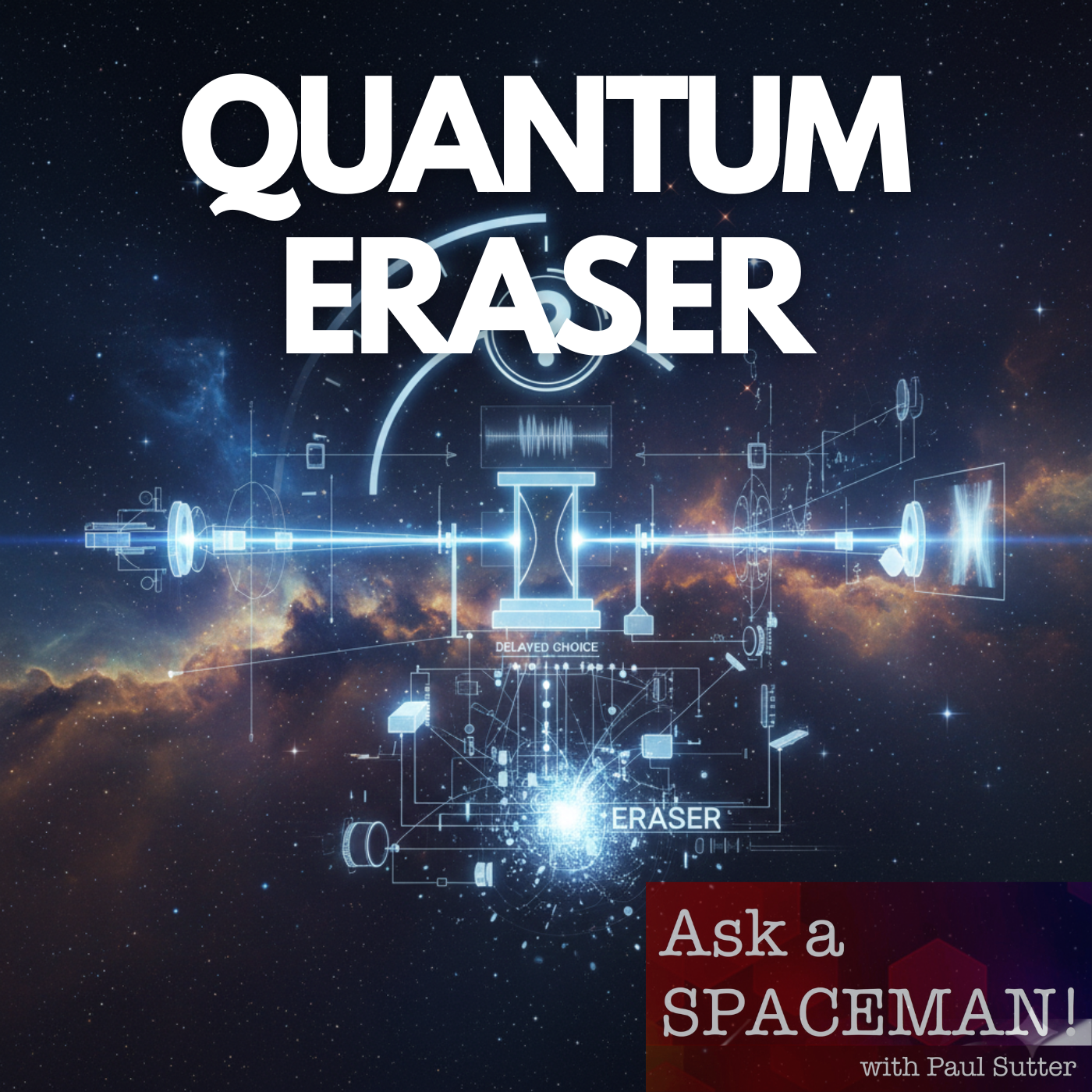
How does the double-slit experiment work? What does it teach us about reality and measurement if we try to mess with the experiment after it’s already started? How does quantum complementarity guide us with how to think about it? I discuss these questions and more in today’s Ask a Spaceman!
Support the show: http://www.patreon.com/pmsutter
All episodes: http://www.AskASpaceman.com
Watch on YouTube: http://www.youtube.com/PaulMSutter
Read a book: https://www.pmsutter.com/books
Keep those questions about space, science, astronomy, astrophysics, physics, and cosmology coming to #AskASpaceman for COMPLETE KNOWLEDGE OF TIME AND SPACE!
Big thanks to my top Patreon supporters this month: Justin G, Chris L, Alberto M, Duncan M, Corey D, Michael P, Naila, Sam R, Joshua, Scott M, Rob H, Scott M, Louis M, John W, Alexis, Gilbert M, Rob W, Jessica M, Jules R, Jim L, David S, Scott R, Heather, Mike S, Pete H, Steve S, Lisa R, Kevin B, Aileen G, Steven W, Deb A, Michael J, Phillip L, Steven B, Mark R, Alan B, Craig B, Richard K, Stephen J, Joe R, David P, Justin, Tracy F, Ella F, Thomas K, James C, Syamkumar M, Homer V, Mark D, Bruce A, Tim Z, Linda C, The Tired Jedi, Bob C, Stephen A, James R, Robert O, Allen E, Michael S, Reinaldo A, Sheryl, David W, Chris, Michael S, Erlend A, James D, Larry D, Karl W, Den K, Edward K, Craig M, Scott K, Vivek D, Barbara C, Brad, Azra K, Steve R, Koen G, and Scott N!
Hosted by Paul M. Sutter.
All Episodes | Support | iTunes | Spotify | YouTube
EPISODE TRANSCRIPT (AUTO-GENERATED)
There are some experiments that just, they make me angry. Not angry at the experimenters, the people behind it, not angry at the design, not even angry at the result. The result is just the result. It's just nature. But it makes me angry at myself. I don't know. It takes a lot. You know how much I love nature and how much I love learning about how it all works and how much I love sharing about how physics sees the world. It's a beautiful lens. And yeah, you know, that's why I do this show because I love it. And if you're like me, which you probably are because you're listening to this show, then you're not afraid of the weird and the counterintuitive and the downright perplexing results that we often get in science. That's part of the fun is challenging our common sense, challenging our prior beliefs, discovering something new and saying, wow, I didn't realize nature could work that way. And then it turns out nature works that way. And that's kind of fun. There's a lot of joy in that. Sometimes there's anger.
Maybe frustration is the better word. Just come on, universe. Can we get a break every once in a while? And yeah, we're talking about quantum mechanics today, which is always a bit of a headache. Because nothing. And I mean, nothing about quantum mechanics makes any sense whatsoever. And every time we encounter a quantum concept, we just have to take everything we know about how the universe is supposed to work and chuck it out the window. But once we do that, at least we can develop a parallel intuition, one that only lives in the quantum realm. Like once we get used to quantum stuff, we realize it's just existing in the quantum universe and the subatomic part of the universe. We don't have to work worry about it here in the macroscopic universe. We're just like, okay, that's just how subatomic systems work. Okay. Particles can randomly appear in different locations. Okay. We can't exactly predict the outcome of a quantum experiment. Okay. Entanglement ties together particles, even if they're really far apart.
Got it. Fine. Thank you, nature. It's weird. Can't really understand it, but at least we can get used to it. And then come people like John Wheeler to tell us that we're still not thinking quantum enough. That even once we develop that parallel intuition that only applies to subatomic systems, and we think we've got a handle on it, and it's all gravy, and it's just, we got it, okay, fine. No, it's not enough. Now, John Wheeler is the kind of guy that deserves his own entire episode, so feel free to ask. And I like to refer to him as the most influential physicist of the 20th century that most people haven't heard of. And one of the many, many, many, he did a lot of things. He coined the word black hole, by the way, just in case you want to get a sense of what he's doing behind the scenes. One of the many things that he did was get us to challenge our assumptions and beliefs and really push ourselves to take our experiments and theories at face value and no matter how ridiculous they may seem.
And one of his ideas make me angry. Not because he was right, because just when you finally think that you have at least half a grasp on the nature of quantum physics, it turns out we're so far away... We might as well be those apes banging away at the monolith. We're just still in the Stone Age here when it comes to our understanding of how the universe works. And we've been at it for a really long time. And I'm kind of proud of the progress we've made so far in science. And it feels like we should at least have a little bit of a grasp. And then it turns out, no. To set up the extra quantum weirdness, we have to go over some normal quantum weirdness. And today's quantum weirdness takes the form of the famous or infamous, depending on your mood, double slit experiment. Now, back when I did that whole series on quantum mechanics, I didn't even really get into the double slit experiment much, just didn't fit into the narrative. So now's now's my chance. Now, versions of the double slit experiment go back for over 200 years, and it was originally developed by a guy named Thomas Young to showcase that there was no way that light could be made up of individual particles.
You know, at the time, everyone bought into this idea of Newton's that light is made of tiny, tiny little bullets that are shooting around everywhere. But he showed, Thomas Young showed, that if you set everything up just right, then light very much obviously behaves like a wave. Here's the idea. You take a light source. It could be a lamp. It could be the sun. It could be a laser. You know, whatever. You just need a lot of light. Then you shine that light on an opaque screen. And that's pretty boring, so we got to do some more stuff to actually get the experiment to work. Just because you're having fun, you'd cut two really, really thin slits in that screen and you let the light leak through those really thin slits. Hence the name double slit experiment. Then you take another screen and place it behind the first one. And you allow the light that sneaks through those two thin slits to have somewhere to land once it passes through on the other side. And you can measure it. Now, here's the magical thing.
That light that hits the second screen doesn't just hit the screen. It shows what's called an interference pattern. which is alternating strips of light and dark. There are places where the light hits the far screen, and then there are places where no light at all hits the far screen. This is exactly what waves do. When a wave, like an ocean wave, passes through a tiny opening, it spreads out from that opening. And if you have two tiny openings right next to each other, then the spreading out waves from one opening bump into the spreading out waves from the other opening. And sometimes the waves add together and sometimes the waves cancel out. This is called interference. Like it's what's used in your noise canceling headphones that you're going to listen to this episode and all of its full audio glory. The noise canceling headphones are generating waves that cancel out or interfere with the waves of the noise from the outside world. And so nothing reaches your ear. You can actually see this play out in real life with ocean waves.
If you happen to be near at a harbor with more than one narrow opening, you can see the waves. You can literally see the waves spreading out from those narrow openings and rubbing bumping up against each other and sometimes canceling out and sometimes adding together, leading to an interference pattern on the shore where you get lots of waves approaching at one place and then like no waves in other places, then alternating back and forth. And you can do it for yourself with light if you feel like building a double slit experiment for yourself. It's actually not all that hard to do if you put your mind to it. So with this experiment, I mean, only waves do this. So Thomas Young was like, hey, I think light is a wave because it's doing obviously wavy things. And so, yeah, we're all done. We can go home and take a nap, right? No, that's never right, sadly. No time for naps today. Grab your favorite caffeine source because we're just getting started. What if you slow down the experiment? What if instead of a beam of light, which contains approximately a bajillion photons passing through every second, what if you made the light source so progressively weaker that you could essentially watch as one single photon passes through the double slits at a time? So not bajillions passing through and all, you know, conspiring together to make a wave, but just one bing, bing.
what you get is one photon hitting the opposite screen at a time, just like a particle. If you have a CCD sensor or some other way of measuring the light intensity, you get a single plop, one bit of light hitting your screen exactly as if that photon was a tiny little bullet that had passed through the slits and buried itself into the screen on the opposite side. You send one photon through your experiment. One photon registers one little dot on the far screen. But then you do it again and again. And again, one by one, the photons slam into the screen at the other side, doing all the things that particles do. Namely, they have well-defined positions. Where did that photon land? You can point to it on the screen. It landed right there. You can't point to a beach and say where the wave landed because the wave, a wave like sloshes over a wide out, spread out area. So you can't just point and say, ah, the wave is hitting the beach right here. Because the wave is all over the place. Particles are not.
You can point to particles. But as time goes on, you see something magical. There are places on the far screen where photons tend to hit a lot. And places where no photon lands at all. And that pattern is in a familiar shape. The on-off stripes of interference. Even though each individual photon always, always, always acts like a particle, lands on the far screen like a particle, hitting like a particle, the buildup of multiple photons acts like a wave. The only conclusion we can draw here, and by the way, folks, we are just getting started into the mind-bending nature of this. We haven't even reached the Wheeler part of how insane this is. The only conclusion we can draw here is the wave-particle duality of subatomic particles like photons. We're used to things being either waves or particles. They can either have well-defined positions and momenta like a particle, or they're kind of spread out and are better described with quantities like frequency and wavelength, like a wave. But photons do both.
Even individual photons do both. One way to think about this, which Wheeler is going to challenge us and make us very, very angry by challenging us, is that each individual photon interferes with itself. We can think that, okay, yes, we send one photon through our experimental apparatus. But it has a wave nature associated with that single photon because everything is both particles and waves at the same time. So even though a single particle lands at the end of the screen, I can imagine this wave associated with a photon passing through the experiment. That wave passes through both slits of my screen. That wave interferes with itself, which triggers the eventual formation of the interference pattern. But the individual photon has to interact with the end screen where I'm measuring everything somewhere. And it does so by landing in a particular spot like a particle. This is peak wave particle duality, folks. The wave nature of the photon tells the photon where or where not where it cannot land.
It interferes through the slits, sets up a pattern and says, OK, photon, you can go there, but you can't go there. And then the particle nature of the photon does the work of actually landing on the screen and lighting up our display. Don't you think this is just light and photons that we need to worry about this? Experimentalists, who by and large as a group did not get enough sleep, have been able to replicate this quantum awareness, this wave particle duality with electrons, with atoms, with Buckminster fullerenes, which are molecules of 60 carbon atoms and even more complex molecules with up to 2000 individual atoms. They are sending like blobs of stuff through double slits and getting their wave nature to come out. Now let's up the ante because we're in that kind of mood. What if we wanted to cheat nature and see which slit the photon goes through? After all, our normal intuition is that, yeah, yeah, yeah, yeah, sure. It's got a wave function that describes where it can go, but it's not actually a wave.
Right. Because it's so obviously definitely a particle because it literally lands on the opposite screen just like a particle would. And if it hit me instead of the screen, it would sting like a tiny little bee and not slosh over me like a tiny little wave. So quit fooling around and show me which slit the particle that is the photon goes through. OK, so you do that. You run the experiment and you change it. You put little detectors over the slit so you can monitor which slit the photon actually passed through. And sure enough, you get little bleeps and bloops and signals telling you which slit the photon goes through. You run one and it goes, oh, left one, left one, right one, left one again, three rights in a row. You obviously see which slit the photon passes through. sometimes on the left, sometimes on the right, never both at the same time for the same photon, always one or the other, just like an obedient particle should. And when you do that, the interference pattern disappears.
Yeah, you heard that right. If you force the experiment to record which slit the photon goes through, it stops acting like a wave completely and switches over to pure particle mode. At the end of the day, at the end of the experiment, the photon is always going to act like a particle because it's going to hit the screen in a particular location. So no matter what, at the end, at the very end, we are reducing, we're getting rid of the wave-particle duality, and we are ending with a particle nature. What we care about with these set of questions is what's happening in the experiment. During the experiment, if we have two slits open and we don't monitor which slit the photon goes through, if we don't try to track its path, the wave nature of the photon comes out. And we see that through the interference path that only waves can do. But if we try to decide which slit the photon goes through, then the wave nature goes away completely and we're left only with the particle nature through the experiment, through the whole entire experiment, and the interference pattern disappears.
This is weird. It's like the photon knows that you're contributing to Patreon. That's patreon.com slash pmsutter where you get to support this show and keep it going. I truly do appreciate it. That's patreon.com slash pmsutter. Thank you so much for all of your contributions. It's like the photon knows what you're trying to get at. That if you remain ignorant... about which path it goes through, the wave nature comes out and you see an interference pattern just like waves do. If you try to pin it down, you try to constrain that information, you try to say, photon, you really need to tell me which slit you're going through, then the wave nature disappears and you only get the particle nature. The interference pattern goes away and it's as if you just sprayed a bunch of tiny little bullets at your double slits. So it's possible to destroy that way of nature by trying to figure out which slit the photon passed through, which is a very particle-like question. This experiment gets right to the heart of a fundamental quantum concept that does not get nearly enough airtime.
That concept is called complementarity. The idea is some paired observable, some things that we can observe that pair off of each other cannot be measured simultaneously. One of those we see as the Heisenberg uncertainty principle. Position and momentum cannot be perfectly measured at the same time. Another way this principle, this idea of complementarity manifests, exists, we see it in quantum systems, is through wave-particle duality. Depending on how we design the experiment, we will get the wave nature of things like photons and electrons and Buckminster fullerenes, or we'll get the particle nature. We only get one or the other, never both. If we start asking particle-like questions of our photons, we get particle-like answers. And if we start asking wave-like questions, we get wave-like answers. If we try to enforce which slit it goes through or try to detect it, that's a particle question, so we only see the particle side. And if we let both slits open and remain ignorant, that's a wave-like setup, and so we get the wave-like result.
Okay. Okay. Quantum weirdness really settling in, and like I said, here comes John Wheeler. We think we have an intuition. Okay, fine. This is how nature is. You get either waves or you get particles. And how you set up your experiment determines which aspect of quantum reality do you see. Okay, in the late 1970s, he proposed a thought experiment. We get that we can set up the double slit experiment. If we keep both slits open, we get the wave picture. And if we try to set filters over the slits to figure out which path the photon took, we get the particle picture. But in either case, we're imagining the photon traveling through the slit, either both at once, which is a wave, or just one, which is a particle, but still traveling. We set up our experiment and then we press go. It's like we have some choice, some input based on how we design the experiment on whether we get the particle picture or the wave picture. It's like nature is responding to our experimental setup. And I know that's literally just how I explained it.
Wheeler said this is wrong. And he was generally considered a genius. Even amongst geniuses, he had multiple Nobel Prize winning graduate students like Richard Feynman and Kip Thorne. They were afraid of how smart he was. So if he said we're missing something overall, it's a good idea to listen to him. It's not necessarily right, but we should definitely pay attention. To really let go, he proposed the following idea. Let's say there's a distant light source, like a quasar sitting billions of light years away. And it sends out light in all directions, as quasars are wont to do. One bit of light heads right for us. Well, take another bit of light that initially sets off on some random path, but maybe it gets bent by a giant gravitational lens, like a galaxy cluster or something, and its path gets bent back to us. So nature just sent us two parallel beams of light from the same source. And we can take these beams of light and try to interfere them with each other right before we detect them.
And we can do it in a way similar to the two slit experiment. We can either do it in particle mode or wave mode. And our natural intuition says that how we set up the experiment determines whether the photon chooses to be a particle or a wave. In our laboratory experiments, this kind of sort of makes sense. But with a quasar billions of light years away, are you seriously telling me that once I make a decision here on Earth, right before the final measurement, that somehow this propagates all the way back for billions of years to decide how the photon actually behaved in all that time? Seriously? Is this how you want me to think about physics? This is me being John Wheeler in the thought experiment. There's a laboratory version of this that came around years after Wheeler proposed this, and it's called the Delayed Choice Double Slit Experiment. In the Delayed Choice Double Slit Experiment, you have an option, you have a button, a lever you can pull to turn on your detectors in the double slits so that you can figure out which slit the photon passed through.
And you set it up and you time it just right so that you only turn on that button after you know the photon has passed through. So check this out. You've got your two slits. They're wide open. You're not monitoring them. You send the photons through. They hit the far screen. Interference pattern. Yay. Wave nature confirmed. Now you send the photons through. Then after they're through, you press the button to turn on the detectors to figure out which path. The interference pattern goes away. You get the particle picture. I will say this again. what appears to be a choice of the photon choosing to manifest as a particle versus choosing to manifest as a wave at the location of the double slits, because that's what's determining. That's what we're, we're one particle picture or wave picture. That's where we're making our choice of whether to see which particle or which slit the particle pass through, which slit the photon pass through. If we wait till after the photon passes through and then go to check, Yeah.
Yeah. The interference pattern goes away. We can make it even worse. It's called the quantum eraser experiment. You send the photons through and then you tag them. I'm skipping over a lot of technical details, of course. You send the tags on a separate course. Then the photons hit the screen. You record their positions. Now you have two options. Option A is to read the tags. You read the tags, which tell you which slits the photons pass through. Boom, the paths are known and there is no interference pattern. Option B, you mix the tags up. You destroy the information. You throw it away. Option B, the paths are unknown. You didn't read the tags. And then there is an interference pattern. So this way, we're recording which path the photon has taken. but we are not observing that information. If we toss away the information, even though we recorded it, if we toss away the information, the wave nature comes out. If we read the information, the particle nature comes out. Keep in mind, try not to get angry about this.
The tags, whether to read the tags or not, that decision is made well after the photons have actually reached the screen. The photons are already done. The experiment's over. They're gone. They've deposited their energy in the CCD and it's just done. And then we decide to read the tags or not. If we read the tags, we will never ever see an interference pattern. And if we don't read the tags, minutes later, hours later, doesn't matter. The moment we decide to read the tags, the interference pattern disappears. Or another better way to phrase it is that once we decide to read the tags, then we go to look at the screen, we'll never ever see. An interference pattern. It looks like our choices in the future are stretching back to alter what the photons do in the past. And this is what makes me so angry. Quantum mechanics is so dang slippery. And it feels like we can get a handle on it. We're like, okay, we're just looking at different sides of the universe, different aspects. Wave nature this, particle nature this, everything.
But now we're affecting things that go back in time. How are we supposed to think about this? Well, Wheeler gave us some guidance because that's what Wheeler did. One option is called retrocausality. It is a view, a lens of quantum mechanics where our choices in the future literally reach back in time. No one's really a big fan of that because it opens up all sorts of nasty issues with causality. But, you know, feel free to play with that model. Maybe I'll do a whole episode on it. Feel free to ask. The other option, the option that Wheeler suggested, is that we're getting all worked up. We're getting all angry. It looks like our choices in the future are affecting what the photon decides to do in the past. In the example of the quasar he gave, we make a choice now, and it looks like it's reaching back billions of years. Wheeler said to just let it go. Let go of common sense. Let go of intuition when it comes to quantum mechanics. Quantum mechanics teaches us again and again and again that our normal intuition that is based on our experiences in the macroscopic world simply doesn't apply.
So why not one more thing? He says it is, quote, In other words, stop thinking of the photon as a tangible entity that must be either a wave or a particle. Stop thinking of them as moving through space acting like a wave or moving through space acting like a particle. They are neither. They exist in a weird quantum superposition that is both at the same time. And that is all there is. The superposition of wave-particle duality until we make a measurement. At the moment of observation, we can only reveal one of two options. But the reality was both. We are just limited in what we see. And when we eventually make a measurement, We're not reaching back in time to alter paths. We're not reaching back in time to change a choice the photon made. What matters is the moment of measurement. And in our moment of measurement, whether it's the delayed choice quantum eraser, whether it's looking at distant quasars, it doesn't matter. What actually happens in flight, so to speak, doesn't matter. Once we ask a particle question, we will get a particle picture.
Once we ask a wave question, we will get a wave answer. It doesn't matter if we set everything up ahead of time or we wait until later. What matters is the moment of measurement. When and always. Only when that happens does the quantum complementarity give way to show us one or the other options. What happens in between is just a bunch of weird quantum stuff that we have no hope of ever really understanding anyway. No one can really say what a photon does as it travels. No one can really say what a photon actually acts like when it travels. We can only say what a photon looks like at the moment of measurement. And when we measure and we get that particle answer, it looks like it had a particle-like path the whole time. And at our moment of measurement, if we ask a wave question, it looks like it acted like a wave the whole time. That's because at the moment of measurement, we only get a view of the whole entire trajectory, its whole entire history through the lens of particles or through the lens of waves.
We never get both and we never really know what's going on. So sometimes you just got to let that stuff go. And maybe I shouldn't be so angry after all. Thanks to John D and Christine L and Don C for the questions that led to today's episode. Keep those questions coming. That's askaspaceman at gmail.com. You can also go to the website askaspaceman.com. Please keep those questions coming. That is the heart and soul of this show. If you feel like it, you can also drop a review on your favorite podcasting platform that helps show visibility. And I love reading your comments and feedback and reviews. And of course, if you are able, I genuinely appreciate all the support on Patreon. That's patreon.com slash pmsutter. And I'd like to especially thank the top contributors this month. They're Justin G., Chris L., Alberto M., Duncan M., Corey D., Michael P., Naila, Sam R., Joshua, Scott M., Rob H., Scott M., Lewis M., John W., Alexis, Gilbert M., Rob W., Jessica M., Jules R., Jim L., David S., Scott R., Heather, Mike S., Pete H., Steve S., Lisa R., Kevin B., Eileen G., Stephen W., Deb A., Michael J., Philip L., and Stephen B.
That's patreon.com slash pmsetter, and I will see you next time for more Complete Knowledge of Time and Space. Thank you.