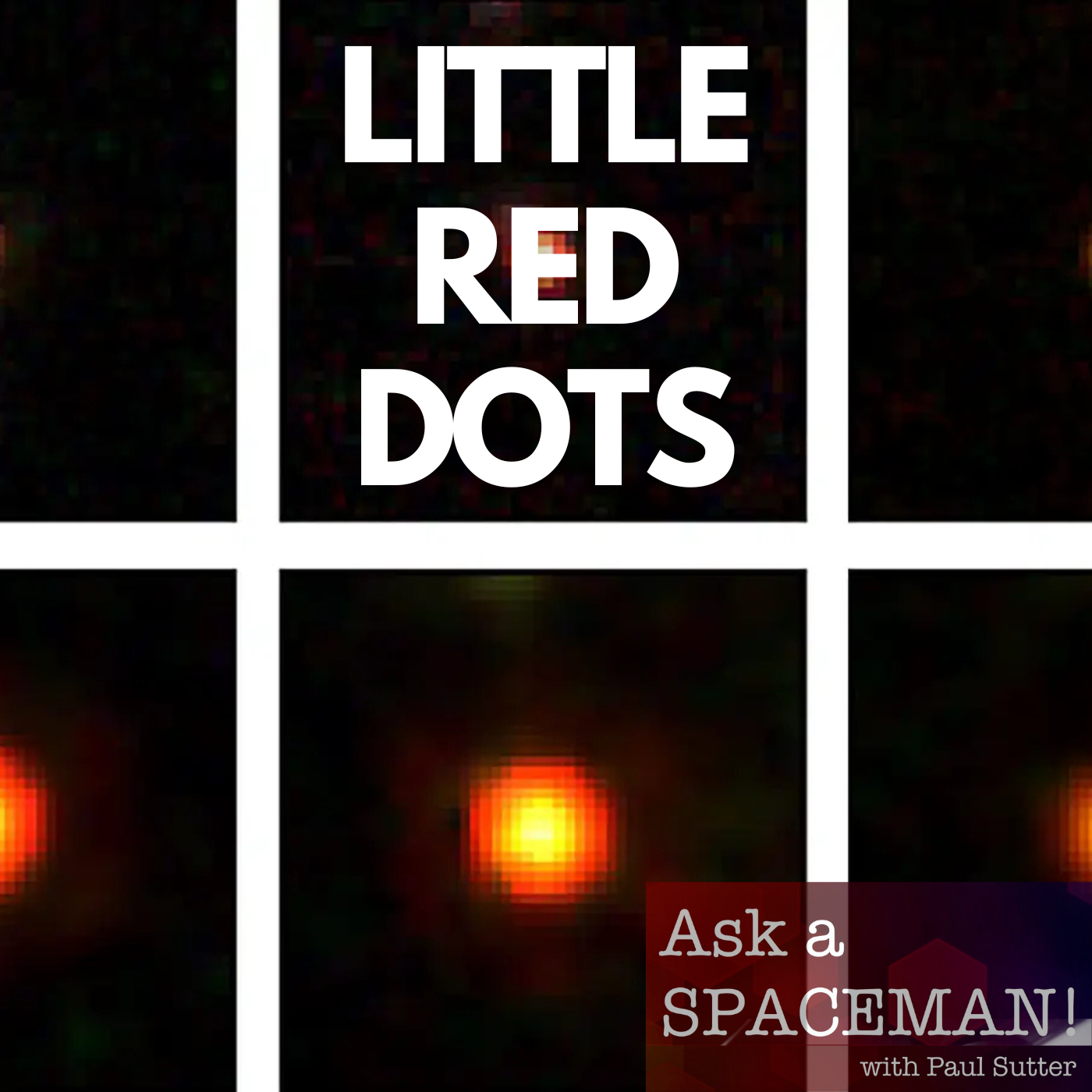
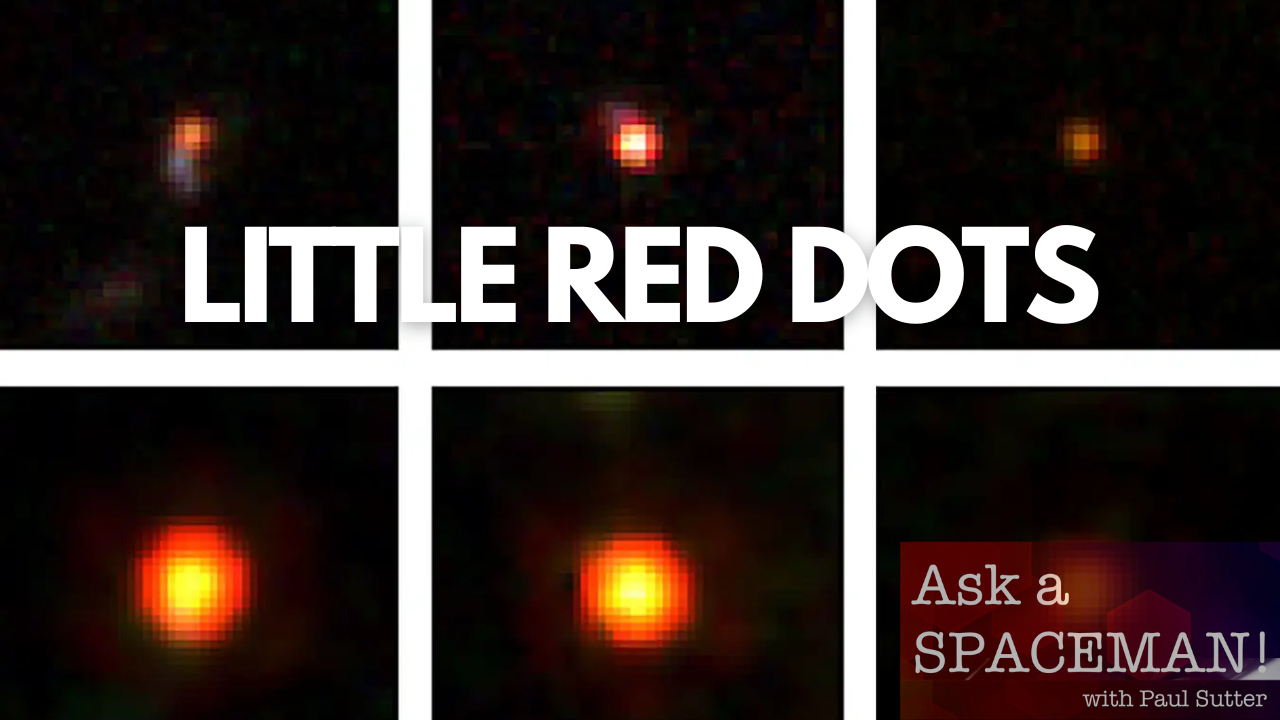
What do we find when we push the James Webb Space Telescope to its limits? Are Little Red Dots newborn galaxies or old black holes? What are they teaching us about the early universe? I discuss these questions and more in today’s Ask a Spaceman!
Support the show: http://www.patreon.com/pmsutter
All episodes: http://www.AskASpaceman.com
Watch on YouTube: http://www.youtube.com/PaulMSutter
Read a book: https://www.pmsutter.com/books
Keep those questions about space, science, astronomy, astrophysics, physics, and cosmology coming to #AskASpaceman for COMPLETE KNOWLEDGE OF TIME AND SPACE!
Big thanks to my top Patreon supporters this month: Justin G, Chris L, Alberto M, Duncan M, Corey D, Michael P, Naila, Sam R, Joshua, Scott M, Rob H, Scott M, Louis M, John W, Alexis, Gilbert M, Rob W, Jessica M, Jules R, Jim L, David S, Scott R, Heather, Mike S, Pete H, Steve S, Lisa R, Kevin B, Aileen G, Steven W, Deb A, Michael J, Phillip L, Steven B, Mark R, Alan B, Craig B, Richard K, Joe R, David P, Justin, Tracy F, Ella F, Thomas K, James C, Syamkumar M, Homer V, Mark D, Bruce A, Tim Z, Linda C, The Tired Jedi, Bob C, Stephen A, James R, Allen E, Michael S, Reinaldo A, Sheryl, David W, Chris, Michael S, Erlend A, James D, Karl W, Den K, Edward K, Scott K, Vivek D, Jennifer D, Barbara C, Brad, Azra K, Steve R, Koen G, Scott N, and M D Malahy!
Hosted by Paul M. Sutter.
All Episodes | Support | iTunes | Spotify | YouTube
EPISODE TRANSCRIPT (AUTO-GENERATED)
I just love astronomers. They're so cute sometimes. Every time they see something new in the sky, they give it a new name. And then we all have to figure out if what they were seeing fits the name or not. Sometimes the name changes, like what they called Nebula. Some of the Nebula turned out to be galaxies, so those got a new name. And sometimes it stays the same, like they identified quasars, and then those stayed as quasars. Although that's complicated because they're also active galactic nuclei, or AGN, which is a broader category than Kluska anyway. No matter what, it seems like with every new telescope, every new observatory, every new campaign, we get a new list of, here's a collection of astronomical objects that don't fit previously known collections, so we put all these new ones in a bucket of their own and slapped a label on it. Case in point, the subject of today's episode, little red dots. That's it. That's their name. Now, of course, astronomers, perhaps out of a small sense of embarrassment, usually in their papers call them LRDs, just like they would say AGN.
But Active Galactic Nucleus is way, way more awesome than Little Red Dot, so sorry, you can't hide from us. We know what you're doing. Little Red Dots are, well, to be fair, that's a pretty descriptive name for what we're seeing. The observations of Little Red Dots come to us from our dear friend, the James Webb Space Telescope. Now, what's really cool about the James Webb is that it's tuned to observe in the infrared. It picks up infrared radiation. It doesn't see a lot of visible light. It sees almost entirely infrared light. So that means the images it produces aren't real images in the sense that you would see the same thing with your own eyes, but it is real in the same sense as when you put on one of those heat vision goggles. We're translating real information about real light into a medium that you can immediately appreciate. It's either that or a bunch of line charts, folks, so you're welcome. Anyway, the power of infrared allows us to see a lot of things. We can see planets around other stars.
We can see newborn systems just hatching out of their cocoons. And we can peer into the early universe. And we can do that because of redshift. So the galaxies that appeared in the early universe, when the universe was less than a billion years old, were emitting all sorts of light. A lot of visible light, a lot of x-rays, some infrared, all of it. But those galaxies are really far away. And by the time the light has finally reached us, billions of years later, the expansion of the universe has stretched that light out, typically down into the infrared. So the James Webb was specifically chosen to be an infrared telescope so that we could open up a window into the very early universe, something no other telescope can do as well as this. How deep are we talking here? Well, pushing the James Webb to its absolute limits gets us to within a few hundred million years after the Big Bang, with the sweet spot of prime observing, which is a combination of the right distance, the right redshift range, and having objects bright enough to be seen at this distance.
The sweet spot is around half a billion to a billion years after the Big Bang. That's when the universe was less than 10% of its current age. And with this newfound capability to peer into the deepest reaches of the universe, we come upon a strange sight. The Little Red Dots. Now, there aren't that many of them, only a few hundred known. But James Webb is a pinhole instrument. It's not a survey instrument. It's not designed to access broad swaths of the sky once and just amass a vast collection of as many objects as possible. It's designed to pinpoint, to stare deeply into one tiny little patch of the sky and see what's there. And so... The fact that even with these little pinholes, these tiny little targeted observations into the deep and early universe, the fact that we can see hundreds of little red dots means that they're very, very common because you would expect if you just took a bunch of pinholes and there was only one little red dot happening out there, that if you take a bunch of pinholes, you're probably going to miss it.
So the fact that we see them pretty much every time we run one of these deep surveys means that they're common. They're actually more common, like 10 to 100 times more common than other objects that we already know to inhabit the early universe like bright quasars. And they're weird. And you know I love me a good cosmological weird thing. What's weird about Little Red Dots? Well, first off, they're small. They're typically less than 500 light years across. That's a hundred times smaller than the Milky Way. Interesting. Okay, but they're small. The universe has lots of small objects. What's the big deal? Well, the big deal is that we're able to see them at all. They're billions of light years away. They're a hundred times smaller than the Milky Way, and they're still visible. Yes, we're pushing the James Webb machine to its limits so they only appear as red smudges a few pixels across, but we can see them. The fact that you can see something that's only 500 light years across... existing when the universe was a tenth of its present age, and they are somehow bright enough to be seen with our telescope, is a testament to just how weird they are.
They are bright, really bright. They're at least 10 times brighter than the Milky Way, despite being 100 times smaller. That's insane. These little red dots pack a punch. And we don't really see them at later stages in the evolution of the universe. It's not like one of our neighbor galaxies is a little red dot or anything. We don't really see them in the modern day universe. There are some hints. With some intermediate deep surveys that go between the present day and the distant reaches that the James Webb can hit, that there might be signs of an occasional little red dot appearing here and there, but they appear to be almost exclusively a feature of the young universe. So whatever made them appear, whatever is making the little red dots had to go away. The unique set of physical circumstances that gave rise to a little red dot made them go away. So this means it has to be a feature. of the formation of galaxies we know that this is the epoch when the universe was less than a billion years old this is when the universe is building its first galaxies so something in that process something in the mechanism that drives the formation of galaxy that leads to the formation of galaxies must produce little red dots, either as an evolutionary step to the formation of galaxies or as an occasional byproduct of the formation of normal galaxies.
And then once galaxies were formed, once the universe was mature, those mechanisms shut off and we don't get new little red dots. Trust me, we've looked. There are no clumps of stuff in the nearby universe that are no more than 500 light years across. that are 10 times brighter than the Milky Way. They just aren't. This only appears in the early universe. So we have tiny, compact, super-duper bright objects that only exist in the early universe. What could they be? These were only discovered a few years ago and then confirmed to exist with multiple surveys in the past couple years. So theories are flying around. The truth is we don't fully understand what a little red dot is, what's causing them, what's powering them, why are they so bright. And we don't understand where they come from, how they were seeded, and then we don't know where they go. Do they grow up and evolve to become normal galaxies? Do they just die on the vine while other seedlings grow up to become normal galaxies? How long do they last? How long are they powered? What the heck is powering them? We don't know.
One possibility is that we are looking at the runts of the litter, so to speak. Like galaxies that tried to form, just like all their other siblings. You know, galaxies start off really, really small and then they grow over time. And so maybe if everything goes right and goes well and you get just the right amount of food and care and nurturing, you grow up to be a steady, mature galaxy with a job ahead. And maybe if you're mistreated as a young galaxy, it may be if you get too many resources too quickly that it ends up stunting your growth. I mean, this makes sense. These dots, these little red dots are obviously red. They are glowing brightly in infrared light. And then we can look around to the modern day universe and ask, hey, does anyone else, like, is anyone else red out here? And there are. There are red and dead galaxies. We have giant elliptical galaxies. that have consumed too much gas, suffered too many mergers, and they've run out of their fuel supplies to keep producing new generations of stars.
And so that's all that's left in these old red and dead galaxies are the red dwarf stars, the stars that can live a very long time. And they've effectively shut off new star formation. New stars tend to be bright and white or blue, while old stars are red. And so, yeah, we see red galaxies in the modern-day universe. And maybe these are just galaxies that consumed too much gas, had too many mergers, couldn't keep the star formation going at a steady state, and just flamed out. And what we're seeing as a little red dot is just a smoldering ember left behind from a once raging fire. Not a bad idea, but it does have some issues. I mean, we do see red galaxies in the modern day universe. Maybe this is a precursor to them or like a different evolutionary path. One of the issues is that to have these little red dots be made of old dying stars, you first need young stars. You need a generation of stars to live and die, maybe a couple rounds of them before you can start producing small stars. Then once you start producing small stars, then all the first generation of stars, the bright ones, they have to die off.
And then you have all that's left is the small red dwarfs, these like dying stars. In the modern day universe, this picture makes total sense because you look at a giant red and dead elliptical. There's been plenty of time for multiple rounds of star formation, multiple rounds, you know, for plenty of time for the big, bright white blue stars to die off, leaving behind the remnant population. Got plenty of time. But we ain't got that time here in the epoch of the little red dots. This really, really challenges our understanding of how galaxies evolve, of how long it took for the first stars to ignite, and then they have to die, and then more generations have to appear, and then you start producing smaller stars, and then the big ones need enough time to die, and then all that's left are the smaller stars. It becomes so strained to produce a little red dot through normal star formation mechanisms that it flies in the face of everything we know about cosmology. Which, yes, of course, cosmology can be wrong.
But some little red dots aren't going to be the ones to do the job. So maybe it's something else. Maybe this, instead of these being populations of dead stars... that were stunted in their growth phase, maybe it's the opposite end of the spectrum. Maybe these are places of intense star formation. I mean, we also have regions of intense star formation in the modern day universe. We're like reaching for analogies here to try to understand what the little red dots are. And we know that the early universe featured rounds of intense star formation. That was something that the early universe was very, very good at when the cosmos was a lot smaller, a lot more crammed in than it is today. So, hey, maybe we're seeing, like, a little pop-off, a little firework in this, like, really compact little galaxy where everything's going off. But, hey, why is it red? Last time I checked, newborn stars tend to be white and bright and blue and hot. These little red dots are not big blue smudges. Like, I don't, what's going on? Well, the answer, the astronomers have an answer for everything.
The answer is dust. Anytime you need to make something red, just throw a bunch of dust in it. If you throw enough dust around one of these galaxies, like if we think of a little red dot as a little nugget of a galaxy, which is 500 light years across, and it has an intense round of star formation, it's like this super clumpy cluster of stars. They're going off like crazy. But if you surround the whole thing in thick, thick, thick, thick layers of dust... It's going to block a lot of light and is only going to let the infrared come through. That's what infrared can do. It can pierce through a lot of interstellar dust, whereas other wavelengths of light are blocked. We call this the dusty starburst model because it sounds cool. But to make them as red as we see, they need a lot of dust. Like, a lot of dust. So much dust. that it's hard to square with the activity going on in the starry. Like you can imagine, okay, we have a bunch of stars, we have a bunch of dust, but those stars are going to be powerful.
They're going to die in supernova. They're going to have stellar winds. They're going to, they have like intense radiation bursts. They're going to push on everything around them. And if you have a thick shroud of dust, you'd imagine this clump of star bursty stars is just going to break on through like, like, I don't like a chicken coming out of an egg or something. And to get the levels of brightness that we need for these little red dots, the stars, we need a lot of stars, folks. We're not talking a few thousand. We're talking a lot of stars crammed into a crazy small volume. We're talking a billion stars per cubic parsec. In our corner of the Milky Way, we have one neighbor that's a parsec away. Proxima Centauri. That's our nearest neighbor. These little red dots for this dusty starburst model to work. In that same volume between us and Proxima Centauri, there needs to be up to a billion stars. That's, yeah, I don't know. That's a stretch. Almost as big of a stretch as contributing to Patreon.
That's patreon.com slash P-M-S-U-T-T-E-R. Feel free to pause the episode right now and contribute. Before you forget, I truly do appreciate all of your contributions. That's patreon.com slash PMSutter. Okay, so Red and Dead Galaxy, stunted, growth, doesn't seem to work. A super active feeding frenzy, growth, I mean, I'm not going to say no, but it's tough. That's a tough one. It's a toughie. There are other weirder options. There are some hypotheses that these might be quasi stars. We are literally seeing this. This is a star that's where you have a black hole and it's being fed by an accretion disk. And then the you have so much gas surrounding the system that the heat from the accretion disk keeps the rest of the gas inflated. So the star stabilizes at like a scale of a few hundred light years across and it stabilizes and it's not powered by nuclear fusion in the core, but by compressed matter falling into the black hole, which is pretty wild. Feel free to ask about that. That's a little bit out there.
That's a fun one. That's a fun one, but it's out there. Initially, when the little red dots were first identified. We had only a rough picture of them. We had snapshots of them in just a few selected wavelengths. And that's called a photometric observation for you astronomy nerds out there. And then once we knew where they were and we knew how to find them, we knew how to spot them, we could use some of the more high-powered instruments on board the James Webb to get a much more detailed picture of what's going on. We were able to get a spectrum. We were able to get observations at many thousands, millions of wavelengths of light. to really get a detailed breakdown of what these objects look like across a big chunk of the infrared spectrum. So instead of just one picture, we have like a million pictures, each one at an individual wavelength, and we can put all this together. And that's when things got really weird with the Little Red Dots. And are you ready for this little nugget of a jargon term? It's a special one.
It's a doozy. Hold on to your hats. It's broad Balmer lines. Broad Balmer lines. Without any context, it just sounds like three random words. What it is... It's hydrogen. Hydrogen emits a certain spectrum of light. It emits very, very specific wavelengths of radiation. We call this series of very specific wavelengths of light emitted by hydrogen. Like if you just take hydrogen gas, you isolate it, and then you heat it up, it's going to glow in a very specific way. It's only going to emit very, very certain specific wavelengths of light. We call that the Balmer series, named after Johann Balmer. So we're seeing Balmer lines in the gas emitted by little red dots. Congratulations, we've discovered that hydrogen is in there. Not a huge revelation. What is the revelation is the fact that the Balmer lines are broad. What this means is that there's hydrogen in there and it's emitting its normal wavelengths of light. So I'm going to spit out a little photon right here with a very specific wavelength.
But if that hydrogen atom is moving around, then sometimes the hydrogen atom is moving towards us and sometimes the hydrogen atom is moving away from us. So it emits its normal wavelength of light. All it knows is it's Balmer series. But because it's moving, it gets Doppler shifted. That radiation emitted by the hydrogen atom gets Doppler shifted. It gets red shifted or blue shifted. If it's moving away from us, it gets red shifted a little. If it's coming towards us, it gets blue shifted a little. So, what we see when we say broad Balmer lines, what we mean is that we are looking out at these little red dots and the hydrogen gas inside of them is moving around really quickly. And what should be nice, sharp, precisely defined wavelengths are getting smeared out because of the Doppler effect. Why is this a big deal? Because there's no way that stars can move around quickly enough to explain how broad these broad Balmer lines are. They're just too fast. The gas is moving around too fast.
We've confirmed gas flows within little red dots of up to 2 million miles per hour. That's 3.2 million kilometers per hour. Millions of whatever your miles, kilometers, doesn't matter. We're in the millions. If this were stars, the galaxy should have just ripped itself apart. But there is one thing in the universe that can make material reach those incredible speeds. And that's giant black holes. Oh, here we are. Case closed. We've got a giant black hole, say 10 to 100 million solar masses. It's buried in the heart of a young galaxy. It's all swaddled in thick layers of dust, which prevents the other wavelengths of light from escaping. Matter falls onto the black hole. It becomes incredibly hot and dense, forms an accretion disk. That accretion disk glows really, really brightly. Most of the light gets blocked by the dust. And then some infrared leaks through. Hey, quasars are super bright. We see them in this same epoch. We see normal, bright, regular looking quasars live in side by side with a little red dot.
So maybe if a galaxy doesn't have a lot of dust around it, we see it as a quasar. And if it does have a lot of dust around it, we see it as a little red dot. Ta-da! Maybe this is how quasars start out, or maybe this is a typical evolutionary path for galaxies. You know, there's an explosion of zits and wild mood swings before it stabilizes down. You know? I mean, you knew this wasn't the end of the episode, right? If you want black holes to power your little red dots, I've got two problems for you, buddy. One small and one big. Actually, one medium problem and one big one. First, the medium problem. To power little red dots, you need big black holes. And for the amount of light that's being emitted, it's relatively straightforward to estimate how big of a black hole you need. So it has enough gravity to generate a large enough Cretion disk that can glow at a certain temperature. It's relatively straightforward astrophysics. Okay, great. Lovely. Where do you get the big black hole? We're in the early universe.
We're not in the modern day universe where big black holes have had plenty of time to get big. We're in the early universe. Where does a 100 million solar mass black hole come from? Now, this is not a new problem when we're studying the early universe because we see little red dots right next to regular quasars. And quasars, those quasars are powered by 10 to 100 million solar mass black holes. And we're asking the exact same question. So at least we're not introducing new questions that we haven't had to face before. It's the same category of questions, which is how the heck do you get big black holes to appear in the early universe? Maybe these black holes are able to form in the first generation of stars and they're able to feed really, really quickly for like 100 million years and they power up and then all of a sudden they become little red dots. Maybe you start out with primordial black holes that merge around a lot. Maybe it's something weirder. Maybe we have dark matter directly collapsing into black holes.
Maybe. Who knows? It's not a deal-breaker for little red dots because it's a general problem we've been facing when we study the early universes. Whoa, hey, wow, the universe is really good at making big black holes, and we don't know how. But there's a bigger problem. The bigger problem is that the little red dots have no X-rays. Quasars, anything powered by a giant black hole, there's a lot of energy. There are pretty high temperatures. There's a lot of radiation. In particular, there's a lot of X-ray radiation. X-rays are one of the signatures of an active galactic nucleus. They're one of the signatures of a quasar. They're one of the signatures of a giant black hole eating a lot of material. They should be screening in X-rays, and they're not. We've checked with the Chandra X-ray Space Telescope. based on the amount of infrared radiation and then you say okay if we're getting this much infrared then the black hole has to be yay big and then okay it's covered in so much dust but we see this much infrared radiation x-ray is also pretty good punching through dust then we expect to see a certain amount of x-ray radiation if we point something like chandra directly at it where we know the little red dot is we should see a little smudge of x-rays and we don't and further mystery that's connected is that the dust if this is a black hole if a little red dot is a big black hole surrounded by a lot of dust the dust should be kind of toasty it could be a little bit warm After all, there's a giant black hole in its center with an accretion disk that's presumably powering something like a quasar.
But we're surrounding it with a lot of dust. But the dust should be warm. And warm dust emits its own radiation signature. It emits its own light. Take a hot ball of dust and heat it up. It's going to start glowing. We should be able to detect the emission from the dust itself. It should have its own distinct spectrum. And we don't. So our most favored model, which is a giant black hole feeding frenzy surrounded by a thick layer of dust, we don't see the signature of either the black hole through x-rays or through the radiation emitted by warm dust. OK, we have a couple options again. You know, we're stretching things here, but this is a brand new thing that we're dealing with. So cut us some slack. Maybe the dust is super duper thick. And yeah, maybe the dust on the inside is warm, but it's so thick. It's hundreds of light years thick that the outside remains cool to the touch. It's also possible that the black hole is feeding so much that it essentially swallows its own x-rays, which is wild to think about.
It bends gravity so much that just it basically snuffs out that part of the signal. Maybe. Maybe it's something else. Here's a kicker to end the episode. Remember, this is active research, so the evidence and observations are coming in practically in real time. Yes, there's a lot of redness in these little red dots, hence the name. But some, not all, but some little red dots also have a little bit of blue. There's an odd amount of ultraviolet radiation coming from some of the little red dots. Not enough to tweak the overall color, still very, very red, but definitely there. Now, ultraviolet radiation is usually the signature of hot young stars, the same way x-rays are usually the signature of a high-powered quasar. Hot, young, new stars tend to emit a lot of ultraviolet radiation. And if we're looking at one of these little red dots and there's like a suspiciously strong component of UV radiation, that means there's the most natural explanation we have for that little bit of excess, extra little bump in the UV, which is weird because there's like a lot of infrared and then not a lot of red, not a lot of yellow, not a lot of blue.
And then an odd amount of ultraviolet. And then no X-rays and then no gamma rays. It's very odd. So maybe when we see some of these little red dots and they turn out to have an ultraviolet component to this, maybe there are a bunch of young, newly formed, big, bright stars. So what the heck are they doing around giant black holes? We don't know. And then there's this one observation, Abel 383. So normally these little red dots are just smudges. They're a few pixels across. Now we can still, that's enough to get the spectrum and get a detailed breakdown of the kind of light emitted by this object. But we can't really tell the interior structure of a little red dot. It's not like we're looking at the Andromeda. We can see the core and the spiral arms and the dust lanes. We just see a little smudge. That's all we got. Remember, we're pushing the James Webb to its limit. But with Abel 383, we got lucky. This little red dot was sitting behind a galaxy cluster. And the galaxy cluster was massive enough that we got some gravitational lensing action here where the image of the little red dot was magnified.
And so it became big enough for us to actually see its insides. And this particular little red dot had some ultraviolet radiation coming out of it. And when observers just by chance happened upon this observation, they discovered that this little red dot was actually two separate things. There was a larger blue clump, which might be a clump of newly forming stars, and then a smaller red clump. which might be a black hole shrouded in thick layers of dust. And these two clumps were actually separated by about 380 parsecs, which is bigger than themselves. And there was what appeared to be a bridge of gas connecting the two of them together. But because we're in normal observations, the James Webb, we're seeing this from so far away, even though these two objects, the blue clump and the red clump, are separated, because of the resolving power of our instruments, they just look smudged together. So could it be... That little red dots are clumps of new stars colliding head-on with feeding giant black holes? Or not? Like, not all little red dots have an ultraviolet component.
If they do, it's not clear if they're always separate objects, like in the case of Abel 383, or if they are connected. It's a mess. The leading theory, the most plausible theory, is that we're seeing something involving black holes. And we know that big black holes play a major role in the early universe. And that maybe they can do wild and crazy things. Maybe sometimes giant black holes are uncovered and we see them as normal quasars. Maybe they're shrouded in thick layers of dust. We see them as little red dots. Maybe sometimes they are attracting or maybe this is somehow related to the galaxy formation process that if you get one galaxy that converts into a giant black hole and then starts feeding on a nearby clump of new stars that's a few hundred light years across that you get this bizarre interaction that leads to a little red dot. And then maybe once those big stars die, we see a normal little red dot. But if the big stars are still there, we see this like ultraviolet component.
Maybe, maybe I do not want to speak of this idea with any degree of confidence, except the kind of confidence born from, you know, this is our best guess so far. Maybe we're on the right track. Maybe we're way off. Either way, little red dots are weird. And I hope they get a new name soon. Thanks to Kyle S. for the question that led to today's episode. Thank you for listening. Please don't forget to drop a review on your favorite podcasting platform that really helps the show visibility. Most importantly, though, you need to send me questions. That's askaspaceman at gmail.com or the website askaspaceman.com. And of course, if you can, I truly do appreciate any contributions to Patreon. That's patreon.com slash pmsutter. I'd like to thank my top Patreon contributors this month. They're Justin G, Chris L, Alberto M, Duncan M, Corey D, Michael P, Nyla, Sam R, Joshua, Scott M, Rob H, Scott M, Louis M, John W, Alexis, Gilbert M, Rob W, Jessica M, Jules R, Jim L, David S, Scott R, Heather, Mike S, Pete H, Steve S, Lisa R, Kevin B, Eileen G, Stephen W, Deb A, Michael J, Philip L, and Stephen B.
That's patreon.com slash pmsutter, and I will see you next time for more Complete Knowledge of Time and Space. Thank you.